The problem
When a customer asks ChatGPT or Claude about a brand, the answer shapes the decision, and nobody was measuring it. Brand visibility was measured in search results and ad impressions only.
What we built
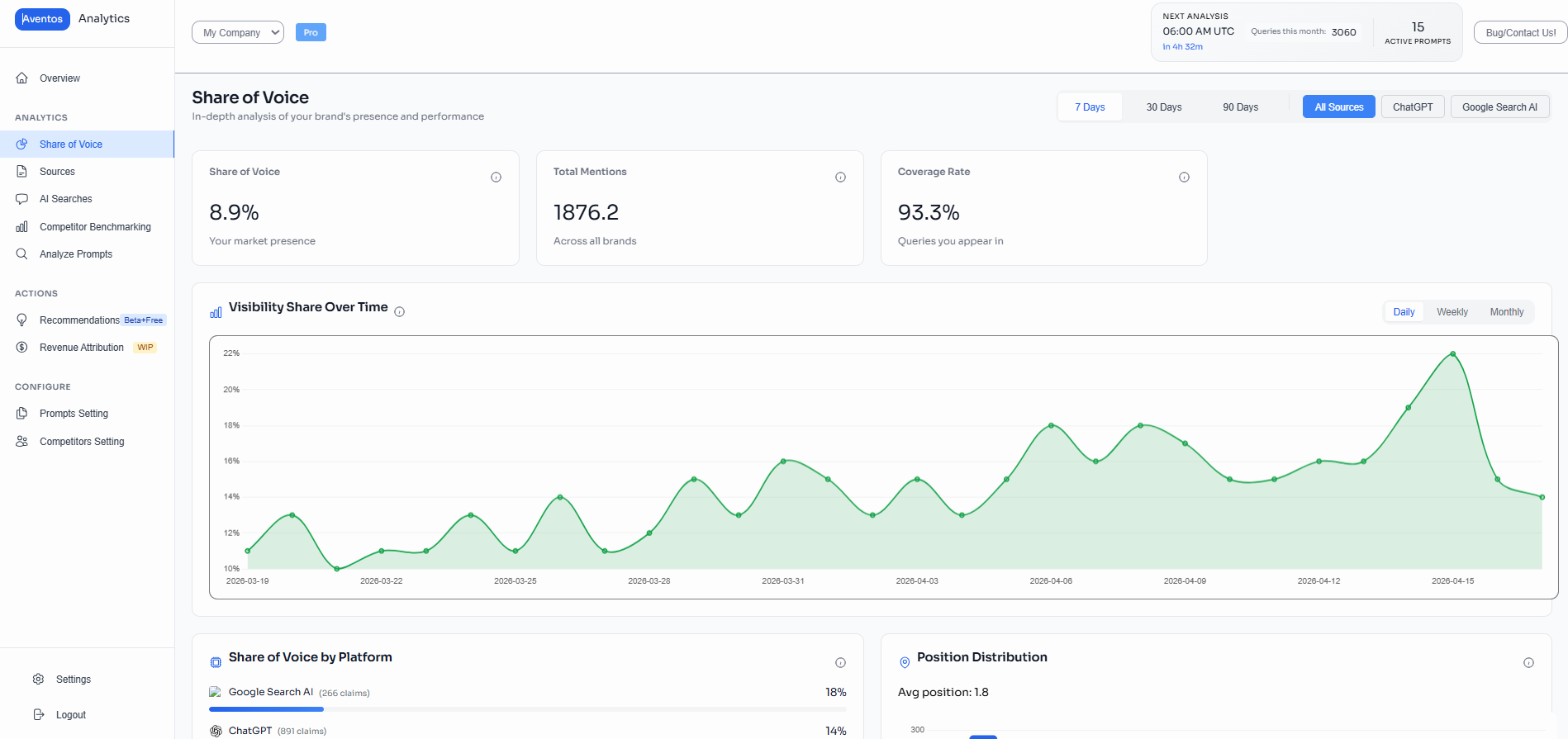
Inventos: prompt sets derived from a brand's real Google Ads keyword data, run against frontier models, with every claim, sentiment and recommendation extracted, scored for impact, traced to its source, and aggregated into a share-of-voice measurement.
Before LLMs you could not read what a model says about your brand at scale, every answer is generated per prompt and varies by phrasing, so coverage required hand-written question lists and manual reading; deriving prompts from real Google Ads keywords and using a model to extract structured claims made hundreds of prompts per run measurable.
How it works, step by step
What a run produces
Claim ledger excerpt with share-of-voice rollup (illustrative). Values illustrative; the shape is real.
| Prompt intent | Model | Extracted claim | Sentiment | Impact |
|---|---|---|---|---|
| "best CRM for small teams" | Claude | Brand recommended as easiest to set up | Positive | High |
| "best CRM for small teams" | ChatGPT | Competitor A listed first; brand not mentioned | Absent | High |
| "<brand> pricing" | ChatGPT | States pricing starts at a tier the brand no longer offers | Negative / inaccurate | High |
| "<brand> vs Competitor B" | Claude | Describes brand as stronger on integrations | Positive | Medium |
What it did not do
- Measures what models say in response to generated prompts; it does not prove why a model says it or guarantee coverage of real user phrasing
- LLM outputs are non-deterministic and change as vendors update models, so share-of-voice is a point-in-time measurement, not a stable metric
- Claim extraction and impact scoring are model-generated and need analyst review; factual accuracy of a claim about the brand is judged by humans, not verified against an external source of truth
How it was measured
- Human spot-check of extracted claims against source completions, measuring precision (claims that exist in the text) and source-trace correctness
- Repeat-run variance: same prompt set re-executed across models to measure how stable share-of-voice is under LLM non-determinism
- Analyst override rate in the review console on impact scores and sentiment labels, tracked per prompt family
Built and shipped by the same team you would talk to
Have a workflow like this one?
Thirty minutes. We map where it is stuck and what a first build looks like.
Book a free AI audit
Next story · Desktop agents