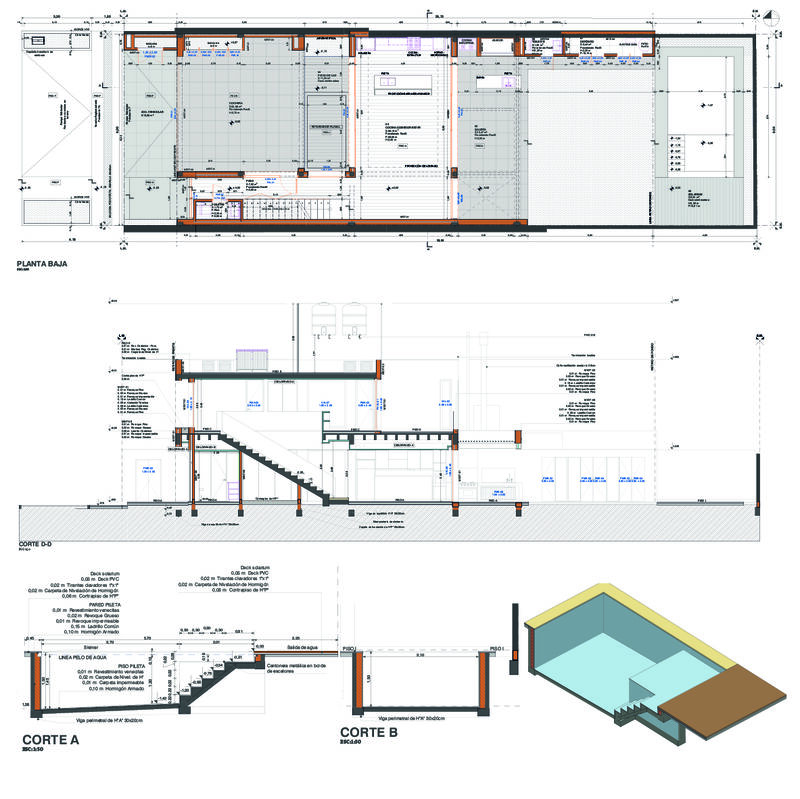
The problem
Checking blueprints against building codes, electrical requirements and contract specifications takes weeks of an engineer's attention per project. Feeding a model the PDF does nothing useful: the drawing is the wrong input format for reasoning.
What we built
A .NET pipeline that ingests architectural blueprints and electrical diagrams and parses them piece by piece into a node graph. Agents then validate that graph against code requirements and contract specifications and return findings a reviewer can accept or correct.
Before AI, code checking meant an engineer reading every sheet and holding the whole building in their head, and naive AI on the drawings failed because a blueprint image is not a reasoning-ready input; reformulating the drawing set as a node graph gave models structured facts they could actually reason over clause by clause.
How it works, step by step
What a run produces
Compliance findings for a project revision (excerpt, illustrative). Values illustrative; the shape is real.
| Graph node | Requirement source | Finding | Status |
|---|---|---|---|
| room:2F-114 / circuit:PNL-B-12 | Electrical code clause (receptacle spacing) | Receptacle spacing along north wall exceeds permitted interval between nodes dev:R-41 and dev:R-42 | Open, engineer review |
| panel:PNL-B | Contract specification (panel schedule section) | Panel schedule on E-301 lists a circuit with no corresponding device node in the parsed graph | Open, possible parse gap |
| room:1F-003 | Building code clause (egress) | Room node has no edge to a corridor or exit node; egress path unresolved | Open, engineer review |
| circuit:PNL-A-07 | Electrical code clause (load calculation) | Deterministic check passed; connected device load within circuit rating | Pass |
What it did not do
- Compliance quality is capped by parse quality, a symbol the vision layer misses simply does not exist in the graph, so it cannot be checked.
- Findings are advisory and routed to an engineer for review; the system does not sign off or replace professional judgment.
- Coverage is limited to what is expressible over the parsed graph plus the loaded code and contract corpus; requirements depending on site conditions or documents outside the corpus are out of scope.
How it was measured
- Graph fidelity check: parsed node/edge counts and types for a sheet compared against a manually built reference graph for that sheet (missed devices, wrong circuit parenting).
- Finding precision on engineer review: share of surfaced findings an engineer accepts versus rejects as false alarms, tracked per rule category.
- Deterministic-vs-agent agreement: on rules expressible as graph queries, compare c8 output to c9 output to detect agent reasoning drift.
Built and shipped by the same team you would talk to
Have a workflow like this one?
Thirty minutes. We map where it is stuck and what a first build looks like.
Book a free AI audit
Next story · Brand intelligence