The problem
Financial education for college athletes was generic and static, while their NIL situations are specific and changing. Applied research on AI in financial decision-making needed a real product to live in.
What we built
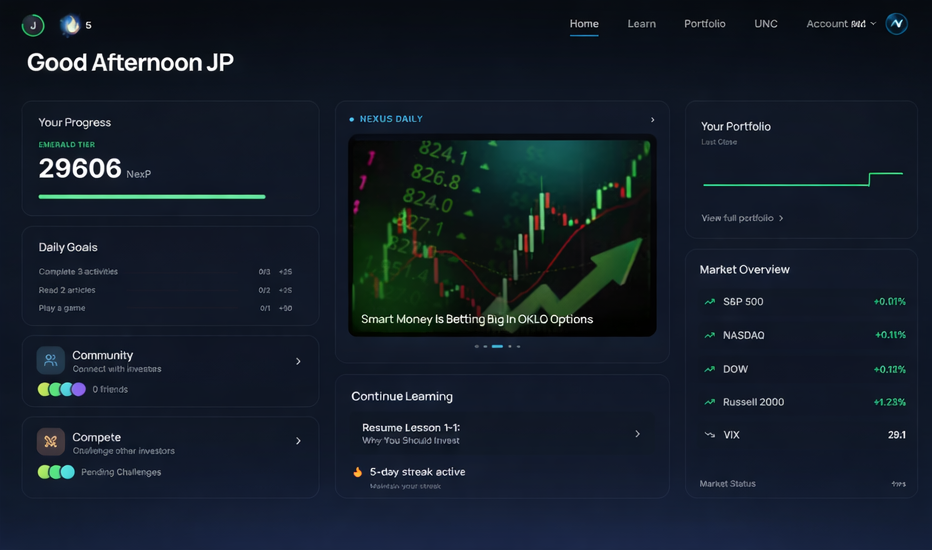
Nexus: a dynamic curriculum, AI tutoring that answers in the athlete's own context, and a certification framework. The financial reasoning engine from the research phase became the substrate for the tutoring layer.
NIL financial guidance had to be one-to-one with an advisor or generic enough to be useless, because tailoring a curriculum to each athlete's deal structure and answering their follow-ups in context could not be staffed; a retrieval-grounded tutor over a fixed NIL corpus plus a deterministic reasoning engine made per-athlete adaptation reproducible at software cost.
How it works, step by step
What a run produces
Athlete learning path and tutor session log (excerpt, illustrative). Values illustrative; the shape is real.
| Module | Adapted because | Status | Tutor exchange | Guard result |
|---|---|---|---|---|
| Self-employment income basics | Profile lists multiple small brand deals | Complete | "Why is no tax taken out of my deal payment?", answered with cited lesson chunk | Cleared |
| Quarterly estimated payments | Prerequisite met; deal income is recurring | In progress | "How much should I set aside?", answered with worked example from calculator | Cleared |
| Contract terms and exclusivity | Profile flags an unsigned agreement | Not started | "Should I sign this contract?", redirected to educational framing | Flagged: advice request |
| Certification review | All required modules pending completion | Locked | , | n/a |
What it did not do
- It is education, not advice: the system deliberately refuses personalized tax, legal, or investment recommendations and cannot substitute for an accountant or attorney.
- Answers are only as good as the curated NIL corpus; topics outside the indexed content are refused rather than inferred, and state-by-state or school-specific rules may be absent.
- No published effectiveness outcomes are claimed here; the certification framework attests to completion against the Shuford rubric, not to financial results for any athlete.
How it was measured
- Groundedness check: sample of tutor answers scored by whether every claim maps to a cited curriculum chunk; ungrounded answers logged as failures.
- Scope-guard test set: held-out prompts mixed between educational questions and personalized advice requests, measuring correct refusal/redirect rate of the guard classifier.
- Calculator agreement: financial reasoning engine outputs compared against fixed worked examples so narrated figures must match deterministic computation exactly.
- Curriculum path validation: planner outputs checked against the prerequisite graph and Shuford certification rubric so no path can complete without required modules.
Built and shipped by the same team you would talk to
Have a workflow like this one?
Thirty minutes. We map where it is stuck and what a first build looks like.
Book a free AI audit
Next story · Neuroscience tooling