Client
Research platform
Industry
Research laboratories
Service
Lab tooling
Runs on
CLI and desktop GUI, Intan and OpenEphys
Status
Shipped
The problem
Neuron imaging analysis required specialist software skills that most labs do not have. The hardware produced signals; turning them into analysis was the bottleneck.
What we built
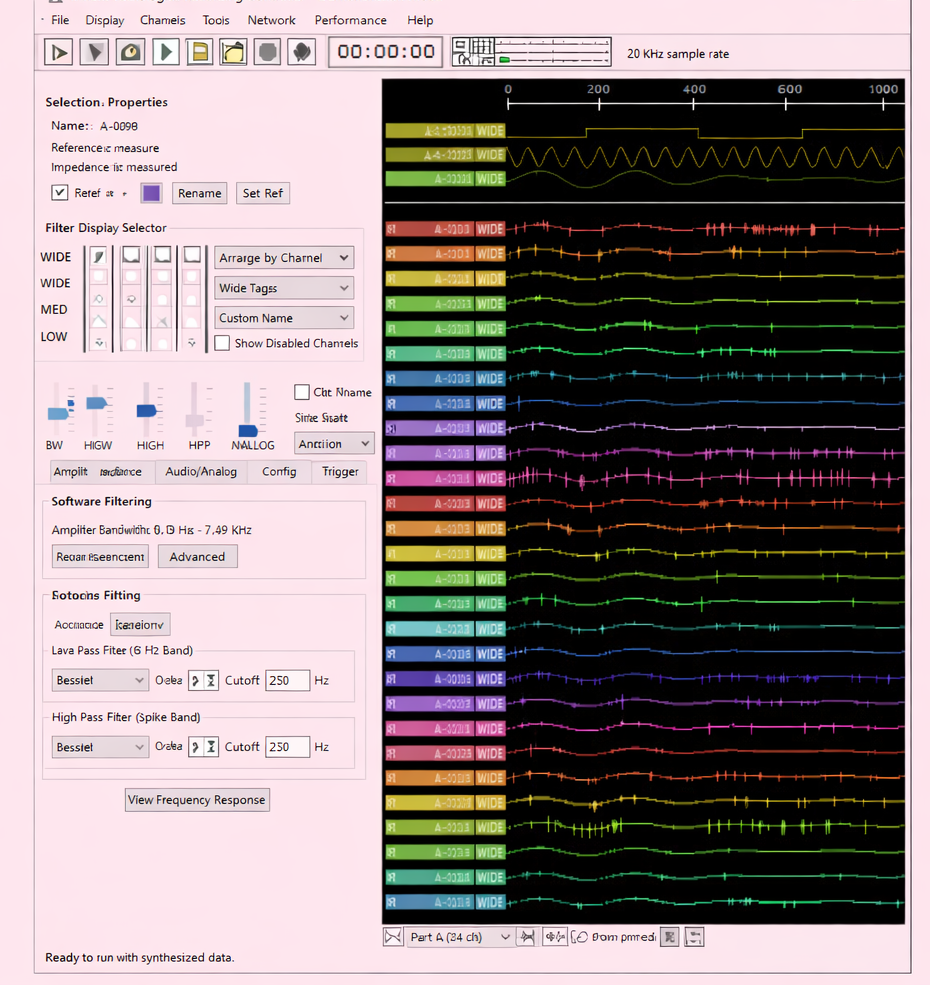
A command-line tool and a recording-controller GUI that parse signals from Intan Technologies hardware, integrate with OpenEphys, and expose the analysis pipeline to researchers without a programming background.
Before this, getting from proprietary Intan hardware files to curated units meant hand-rolled lab scripts per rig, so analysis was only reproducible by the person who wrote it; a parser, a config-driven pipeline, and a GUI made the same run repeatable by any lab, with an LLM assistant lowering the barrier to writing the config.
How it works, step by step
Intan recording hardware
source
Intan RHD/RHS controller, .rhd/.rhs binary + USB stream
Raw multichannel amplifier data
OpenEphys acquisition system
source
Open Ephys binary/continuous format, ZeroMQ event stream
Second supported acquisition path
Classical DSP: MAD-threshold detection, PCA feature extraction, template matching with k-means clustering
Detect spikes and assign them to putative units across channel groups
Guardrail: Units failing SNR and ISI-violation thresholds are flagged, not auto-accepted; all sorting is re-derivable from the stored config hash
Claude (Sonnet)
Turn a plain-language analysis request into a pipeline YAML config for the CLI
Guardrail: Output must validate against the pipeline JSON Schema and is shown as a diff for user confirmation; the assistant never writes data or interprets results
What a run produces
Session unit summary (excerpt, illustrative). Values illustrative; the shape is real.
| unit_id | channel_group | spikes | mean_firing_rate_hz | flag |
|---|---|---|---|---|
| u-001 | shankA/ch3-6 | 14,208 | 4.7 | accepted |
| u-002 | shankA/ch7-10 | 2,915 | 0.9 | review: low SNR |
| u-003 | shankB/ch1-4 | 31,640 | 10.4 | accepted |
| u-004 | shankB/ch5-8 | 1,102 | 0.4 | review: ISI violations |
What it did not do
- It is an engineering platform, not a new sorting algorithm: the spike sorting is classical PCA/template-matching, not a research-grade improvement over established sorters.
- The LLM assistant only generates and validates configuration; it does not sort spikes, curate units, or interpret neuroscience results.
- Support is scoped to the described Intan and OpenEphys paths; other acquisition hardware, closed-loop stimulation control, and downstream statistical inference are out of scope.
How it was measured
- Parser fidelity: decoded Intan .rhd/.rhs sessions compared sample-for-sample against Intan's own reference reader output, including aux/digital channels and sample-rate/gain metadata.
- Sorting sanity on ground-truth-style inputs: synthetic and hybrid recordings with known injected waveforms scored for detection hits, misses, and false merges; ISI-violation and SNR metrics checked per unit.
- Live-path stability: recording controller GUI run at the hardware's sustained sampling rate for long sessions, asserting zero dropped data blocks and bounded UI latency.
Built and shipped by the same team you would talk to
Have a workflow like this one?
Thirty minutes. We map where it is stuck and what a first build looks like.
Book a free AI audit
Next story · Regulatory AI